Tuesday, June 25, 2013

Cuberes

For more than 10 years I regularly visit Boumort, a big area declared national hunting reserve because of the big amount of Red Deers (Cervus elaphus) living there. Some years I used to go there for 10 days in summer and a couple of weekends more, one in May and another in September-October in order to heard some Red Deer's belows.
The mountain range is situated in pre-pyrenees, and its highest peak is Cap de Boumort (2077 m). The area  combines some lower areas (typical inland mediterranean) and some pyrenean habitats, usually separated only for a few metres. This high habitat diversity causes also a high species variety.

I'm in love with that place since I came there for first time and, throught the years, the place has become something like my second home. I also dare to say that, probably, my life would have been very different if I had never gone. When I'm there, I live in Refugi Cuberes. Gabi, Anna, Guillem, Jana and Nina; the family who take care of the refuge, are my family there.

  
This time I went there with Elena, Guillem, Santi and Vicki and three families more. I passed a great weekend with them and I'm pretty sure they enjoyed it too. You can follow some interesting reviews of  their 'in family excursions' in Santi's blog (in Catalan). A post about Cap de Boumort, where we went also two years ago, is available too. 

On Friday, I looked for a place outside the reserve where I could try to ring some interesting birds. Only 16 captures in two days, but was ok and I think all children (and also no-children) enjoyed it a lot!

For me, the most interesting bird was a Coal Tit (Periparus ater), because I had never trapped this species.

Later, It was also very good this Firecrest (Regulus ignicapillus) that was caught on the nets.


Chaffinch (Fringilla coelebs) was the commoner bird during ringing. I was accustomed to ring them in winter and I was quite surprised because of the bright colours on males plumage. What a beautiful birds, isn't it?

Despite the Coal Tit capture, the most surprising birds were probably 3 Serins (Serinus serinus). Some years ago I heard the fisrt male singing in that area and this time I ringed a female with broodpatch.


The last bird was this beautiful Garden Warbler (Sylvia borin), a female with broodpatch too. I'm used to ring this species during migration, when they have a lot of fat accumulated in their body, but they don't need that for breeding. 

In Boumort, the star-species are not birds. They are mammals. Red Deers (Cervus elaphus) are extremely abundant (too common in my opinion...), so it's really easy to see some of them. Also Roe Deers (Caperolus capreolus) are easy to see, specially in June, when you can find some young deers walking through the forest. Wild Boars are also present, but not in spectacular densities so it's not as easy to see as another parts of Catalonia (i.e. Barcelona area). European Hares (Lepus europaeus), Foxes (Vulpes vulpes) and Beech Martens (Martes foina) are also common mammals there. But don't forget the Pyrenean Chamois (Rupicapra pyrenaica), scarce but also present.


Boumort is the place where, every year, I can 'meet again' some pyrenean species. This weekend I was so lucky and I found some Ring Ouzels (Turdus torquatus), some Citril Finches (Serinus citrinella) (not so far from Serins singing!), an Egyptian Vulture (Neophron percnopterus), some Bearded Vultures (Gypaetus barbatus) and I also assisted a master class of Common Treecreper's (Certhia familiaris) field ID.
I'll miss again this magic silhouette...
... and also this magic place. I hope I can come back home very soon.

Monday, June 3, 2013

Chicks and cherries

This year I started a constant effort ringing station in La Corbatera, close to my village. Yesterday I did the third session of the season and I trapped another interesting bird that is breeding there. The most interesting birds in this season are a Wryneck (Jynx torquilla), a Turtle Dove (Streptopelia turtur), an European Bee-eater (Merops apiaster), an Eurasian Jay (Garrulus glandarius) and a Golden Oriole (Oriolus oriolus).


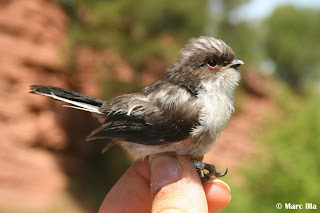
I've already ringed some chicks. At 1st May I trapped the first Blackbird (Turdus merula) and two Long-tailed Tits (Aegithalos caudatus), and during two last days I also trapped a juvenile Song Thrush (Turdus philomelos), 2 European Robins (Erithacus rubecula), 2 Blackcaps (Sylvia atricapilla), a Great Tit (Parus major). Juvenile Winter Wrens (Trogoldytes troglodytes) are flying too, and at the same time, Reed Warblers (Acrocephalus scirpaceus) are just laying eggs and some of them are still migrating.


In previous weekends I was ringing too in l'Aiguamoll de la Bòbila and I trapped also a lot of breeders but only House Sparrows (Passer domesticus) and Starlings (Sturnus sp.) chicks. However, I caugh two very interesting birds in 18th May: a Grasshoper Warbler (Locustella naevia) and an unexpected Monk Parakeet (Myiopsitta monachus)!


It is also the season of cherries. It will be easy to see some birds eating them... I will ring close to cherry trees these days.
Yesterday afternoon I picked cherries with Elena, Guillem, Alba, Vicki, Santi & family.


In the evening I tried to ring some Nightjars, and finally I trapped this handsome europaeus male.


But the most interesting bird was a Long-eared Owl (Asio otus) chick!!!

Wednesday, May 29, 2013

Travel to France

During last winter I ringed some Song Thrushes (Turdus philomelos) wintering in my local patch, l'Aiguamoll de la Bòbila. I can remember well one of them, ringed in 26th January, because of a malformation in its right leg.
This same bird was found dead in 23rd April 411 km far, close to Brantôme (France), by Emilie Segard.

Map made with Google Maps
Another Song Thrush ringed last winter.
After a Polish Reed Bunting (Emberiza schoeniclus) and a French Penduline Tit (Remiz pendulinus), it's the third foreign recovery related to my local patch!

Tuesday, May 28, 2013

Lilford's Wall Lizard

In the last post I told about Balearic bird subspecies, but another very interesting endemic fauna are the reptiles. Lilford's Wall Lizards (Podarcis lilfordi) and Ibiza Wall Lizards (Podarcis pityusensis) are two very interesting endemic species. The first one, the theme in this post, lives in some small islands and rocks around Menorca and Mallorca. The second one, pityusensis, lives in Ibiza, Formentera and some small islands around. Both of them have lots known subspecies, each one endemic of every small island.

This high variety is consequence of the separation between the islands and small islands that are partof the Balearic archipelago. Therefore, the most separated small island is Illa de l'Aire, and its endemic subspecies of Lilford's Wall Lizard, Podarcis lilfordi lilfordi, its considered to be the first one to separate from the antecesor form. This subspecies is quite 'famous' for its amazing colour: black on upper parts and deep blue on under parts, and for be the Lizard's population with the highest density in the world.


Actually, there are lots of Lizards around whole Illa de l'Aire and they are extremely common everywhere. Just see what happens if you leave food on the floor:


Their colour is something strange, and with no explication for the moment. Their extreme confident is probably consequence of the lack of predators, and humans are not a clearly threat for them. During my stay in l'Illa de l'Aire, we were living together. As you can see in the video, it was made very close to the ringer's house.

I also have the luck to meet Valentín, an expert herpetologist that has been studying Lilford's Wall Lizards for many years. He was realizing some behaviour experiments with different subspecies with some assistants, and I managed to learn some interesting things about. I really want to read their results!

Colour marked lilfordi.
Another interesting endemic, closely related to Lilford's Lizard, is the Dead Horse Arum (Dracunculus muscivorus). The flower smells very bad, like descomposed meat, in order to attract flies (in charge of the pollination).

In Catalan, it's called Rapa mosquera or Orella de porc.

Thursday, May 23, 2013

Balearics

After being ringing in l'Illa de l'Aire, in Menorca, you will probably feel weird when you arrive at home. Living in that small, uninhabited and wild island you will feel in great harmony with wildlife. I have to reccomend everybody interested in to spend there some days and enjoy all of that things.

I have to talk about some great people that makes tha ringing campaign possible: Raül Escandell, J.J.Carreras, Santi Catchot, Xavi Méndez, Joan Florit, Emili Garriga, Alicia Pioli... I'm very grateful with them for his high hospitality and better personality. A big hug for everyone!

Last year I visited for first time the island in April. This time, my visit was in May, so migrants were quite different and I could enjoy some different species than the previous year. If I want to talk about all things I learnt and about all species that I trapped, this post would never end. So... let's talk about Balearic subspecies, my new birding obsession.

Hardly ever, islands have lots of interesting species, subspecies or populations that are known to be endemics or simply specials. Everybody knows the Blue Chaffinch (Fringilla teydea) or Giant Turtles from Galapagos. Balearic islands are not the exception, and probably most 'popular' endemics are the Balearic Warbler (Sylvia balearica) and the Balearic Shearwater (Puffinus mauretanicus). But this time, I prefer to talk about subspecies. 

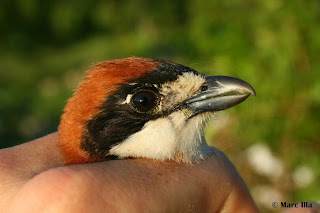
Balearic Woodchat Shrike (Lanius senator badius) breeds in Balearic Islands, Corsica and Sardinia. It differs from the nominate form in the following main characters:
- Size: bigger than other subspecies, hardly ever wing lenght > 100 mm.
- Big and strong bill.
- Small or absent white patch on base of primaries with closed wing.
- Narrow black patch on forehead.

Look at the white patch on the basis of primaries,
some badius have a small patch if the wing is slightly open.
I'm actually careful about identification in the field, without trapping the bird, so I never consider as 100% sure an identification of a badius without measurements (always talking about observations out of the breeding area). This subspecies is not a very rare bird in Catalonia and in south France, where every year some birds are detected.

Moltoni's Warbler (Sylvia (cantillans) moltonii) breeds in Balearic Islands and also Corsica and Sardinia. Its identification in the field can be quite tricky if the bird doesn't call (easy feature to recognise that subspecies, because of the similarity with the Winter Wren Troglodytes troglodytes call). Only males could be recognisable 100% sure (females are usually unidentifiable also in hand), and the main character is the plumage colouring: salmon-pink on breast, without any traces of orange, and a bluish-grey on upper parts. Also, the very extensive (usually complete) prebreeding moult can also help to a correct ID: birds in spring have a very fresh plumage.
Look at the remiges borders, the bird had moulted
primaries but has retained some secondaries.

Moltonii is also not a very rare bird in Catalonia and southern France in spring, but observers have to be careful with identification, specially if the birds is not trapped during a ringing session. Light fools, and colours could be tried erroneously.

Balearic Spotted Flycatcher (Muscicapa striata balearica) breeds only in Balearic Islands and is probably the most recognisable balearic subspecies. In the field, the pallid upper parts and traces of white on the crown usually attracts the attention of the observer. In hand, these subspecies is smaller than the nominate one, but the best criteria is the position of the 2nd primary feather with the wing closed, that it rests between de 5th and the 6th in balearica and between the 4th and the 5th in striata. Also, balearica shows clear white in breast and underwing coverts, that is a 'dirty' white in striata.

Left bird: balearica. Right bird: striata.
As I said before, usually a correct identification could be very tricky. I have to reccomend to be careful  with 'difficult ID birds' and ask for opinions to other birders when you have any doubt.

Thursday, May 9, 2013

Illa de l'Aire

Yestarday afternoon I arrived in Menorca. Emili, one member of SOM (Ornithological Society of Menorca), was waiting for me at the airport.

This morning, Emili has taken me with Xavi and Joan, in a constant effort ringing station. Although no more than ten birds during firsts rounds, I have enjoyed a lot a couple of 'Balearic' Woodchat Shrikes (Lanius senator badius).

At 10 o'clock I was already in Illa de l'Aire, a small island in south Menorca that is a really important place for birds that are crossing the sea. I'll be ringing in a ringing campaign here, that has been carried out for more than 21 years. There, I met Raül Escandell, J.J. Carreras and Santi Catchot, and also a big fish trapped this morning (not in the nets!!), that we've eaten for lunch.

Today we have ringed 120 birds, specially Willow Warblers (Phylloscopus trochilus), the commonest bird here. I have really enjoyed a Balearic Spotted Flycatcher (Muscicapa striata balearica) that has been trapped in the first round.

Be here is a great experience. I really reccomend everybody interested to visit this fantastic place for migration. You can follow this blog to see some interesting things about the island and migration.


Wednesday, May 8, 2013

More from east!

Last weekend I was ringing at Aiguamolls de l'Empordà Natural Park, participating in a spring campaign that starts on March and finishes by late May.


The strong passage of Reed Warblers (Acrocephalus scirpaceus) occurs on early-mid May here, so I was psychologically prepared to ring lots of them. As it was to be expected, we trapped more than 70 scirpaceus in Saturday morning and a total of 100 birds, not big numbers but quite good. This year, because of the winds, Wood Warblers (Phylloscopus sibilatrix) are quite common in the typical sites although the fantastic squall is far away. In this ringing station sibilatrix are ringed nearly every day.


It's also a good time for Grasshopper Warblers (Locustella naevia). We heard some birds singing from bushes and we trapped one of them.


Flycatchers are also quite abundant these days. I was compulsory to confirm every Ficedula as a hypoleucos... despite the fact that all albicollis seen last week seemed to be already gone, I expect the possibility to see one.

We saw some Squacco Herons (Ardeola ralloides) in the Matà area, and also some Hobbies (Falco subbuteo), 4 Gull-billed Terns (Gelochelidon nilotica) and a Collared Pratincole (Glareola pratincola). Not rare birds, but also not fairly common.


In midday, we take advantage of the opportunity to go to another birding sites close to the ringing station. We found a fantastic field by chance, just beside the road. There were lots of Whiskered Terns (Chlidonias hybridus), and between him, 3 White-winged Terns (Chlidonias leucopterus)! A really beautiful bird to see.

Still happy for the WWTerns, we found an adult male Red-footed Falcon (Falco vespertinus) in one of the typical places: La Gallinera ricefields.


A Great Snipe (Gallinago media) was found by Àlex Ollé very close to the ringing area on Friday. With Bernat Ferrer (who went with my all weekend) and Ponç Feliu, we tried to see it on Sunday. Bad luck this time, we only say Common Snipes (Gallinago gallinago)... some Ruffs (Philomachus pugnax), Wood Sandpipers (Tringa glareola), Black-winged Stilts (Himantopus himantopus), Common and Little Ringed Plovers (Charadrius hiaticula and dubius), and 2 Little Stints (Calidris minuta).