Tuesday, October 27, 2015

End of October, already

Time is flying, and I still don't have time enough to post all the stuff I would like to!!
Leaving many things hidden in my computer, this post will be about last week, birding around my place in central Catalunya.

Very little few transaharan migrants are still around Catalunya, mostly Swallows, Common Redstarts (Phoenicurus phoenicurus) and Reed Warblers (Acrocephalus scirpaceus). On the other hand, these dates are especially good for presarahan migrants: Blackcaps (Sylvia atricapilla), Robins (Erithacus rubecula), Song Thrushes (Turdus philomelos) and Chiffchaffs (Phylloscopus collybita).

Now it is also the best time here for migrating Firecrests (Regulus ignicapilla). Sexing is like in Goldcrests (Regulus regulus), but females usually have pale orangish crown, not completely yellow as in female Goldcrests.
Female. Crown feathers are orangish but not brightly coloured.
Male. Even without showing all crown feather, orange is very
bright.
It seems it is going to be a good year for both European Siskins (Spinus spinus) and Hawfinches (Coccothraustes coccothraustes), both species that have different abundances depending on the winter. I have personally seen them usually during last weeks, and I even had the chance to catch this very nice adult male Siskin.
Last days have been also especially good for Stonechats (Saxicola rubicola) around my area.
First-year (EURING 3) male. All GCs and tertials moulted.
First year (EURING 3) female. All GCs and tertials moulted.
First-year (EURING 3) female. All GCs and two tertials moulted.
First-year (EURING 3) female; with 3 outer greater coverts
retained.
Adult (EURING 4) female.
Meadow Pipits (Anthus pratensis) and Water Pipits (Anthus spinioletta) are also appearing on migration and, some of them, reaching the wintering grounds. From the latter species I trapped two individuals last week, and one of them turned out to be a retrap from February!
First-year (EURING 3). Only a few lesser coverts are moulted
in the postjuvenile moult. The extension, as it happen also with
the Meadow Pipit (Anthus pratensis) is quite variable, involving
a few inner GCs and tertials sometimes.
Adult (EURING 4)
The same river place provided also a first-year Grey Wagtail (Motacilla cinerea) and 5 Kingfishers (Alcedo atthis).


I had also some very unexpected birds!
One Scops Owl (Otus scops) was still around last week, being the latest record in my area so far. It was a first-year (EURING 3), with fat score 5!
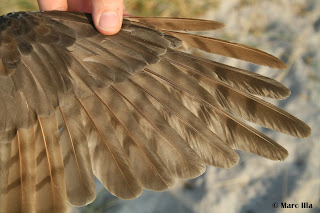
Pale coloured flight feathers, with faint pattern and pointed tips
are typical of first-year birds, Below, tail show very diffuse barring,
almost lacking the black bars. In spring, birds can be age on the same
characters, but with more wear on the feathers.

The last Rock Bunting (Emberiza cia) I saw in my local patch was 5 years ago. Last Saturday, this first-year (EURING 3) female was unexpectedly caught for ringing!, being the first ringed in my place.
As many Emberiza species, all GCs where moulted. Moult
limit is especially easy to see in this second picture, being both
carpal covert and the smallest alula feather moulted.
Faint dark marks and cold tones overall make this bird a female.
Also, the first ever ringed Lesser Spotted Woodpecker (Dendrocopos minor) came on Sunday.
Sex is quite easy, being this bird a male on the reddish feathers
in the forehead. Ageing is a bit more difficult. This bird is a
first-year (EURING 3), with new primaries, lesser, median and
most of the greater coverts and small alula feather moulted.
Pattern of unmoulted secondaries, tertials and primary coverts are
 the most striking features on ageing this bird.
Also, the central pair of tail feathers were moulted. See
differences in wear, but also texture (quality) between
the two generations.

Wednesday, October 7, 2015

Falkar

During last month I have got almost no time at all to sit and write something. Among the amount of stuff I could post about, these birds deserve a place in the first one.

Raptor migration is Falsterbo is always very exciting. Numbers of many species are just impressive, Sparrowhawks (Accipiter nisus) for instance.
While working on the standardised ringing scheme in Flommen reedbeds, we trapped some Sparrowhawks in a extra net placed close the one of the very few bushes on the area. It turned out to be quite succesful!
First-year (EURING 3), the commonest age class so far.
Second-year (EURING 5) female, in active primary moult.
But the best bird we trapped was another raptor species, that was only the 6th ever trapped in Falsterbo Bird Observatory: a Merlin (Falco columbarius).
The last one to be trapped was in 2011, when Stephen was in Falsterbo for first time. Actually, he just came for a visit when we got the Merlin!
First-year (EURING 3) male
That was a very nice bird, but even more surpsised were coming in the next days. 10th September was actually a very nice day. Early in the morning, during the first netround, we trapped an unexpected Yellow-browed Warbler (Phylloscopus inornatus) in the reedbeds!
That is the earliest record ever in the Falsterbo peninsula, being the previous record at 13th September. Hours later, we found another Tajgasångare in the bushes close to our ringing hut!, and actually, Jonas Ekwall found a third individual that afternoon!!

The best was yet to come. Back to the station, we went for a walk around Falsterbo Park with Josefina. As is usual by this time of the year, many first-year Hobbies (Falco subbuteo) fly around, hunting dragonflies. They can actually be seen at close range sometimes!
We were saying it would be very nice to catch one... but of course it was difficult. A few minutes later, while walking through a quite dense part of the park, we suddenly heard a Falcon screaming behind of us. A big Falcon landed with a prey on the feet like 30 metres far from us. The first thing that attracted our attention is that the other bird, the supposed prey, was still alive and it was actually another Falcon!
A quick look with the binoculars revealed they were two juvenile Falcons, a Peregrine (Falco peregrinus) and a Hobby (Falco subbuteo). The Peregrine had clearly hunted the Hobby, but the latter was still alive and fighting to survive. Without almost no hopes for it, we started running to try to catch them. And we trapped them by hand.
First-year (EURING 3), unsexed. There's some overlap between
both sexes in Hobby. 
First-year (EURING 3) male. Sexed on measurements.
The Hobby (Lärkfalk in svenska) was the 7th ever ringed at Falsterbo Bird Observatory, and the Peregrine Falcon (Pilgrimsfalk in Svenska) was actually the first ever ringed!!!, and also the species number 200!! Could anything be better??


Monday, August 24, 2015

Lugn lilla skarven

During last days we have been out some nights to catch some birds in extra ringing. We used both nets for waders and a big lamp for lamping, and the results have been quite interesting so far. This post will be focused only in the two Great Cormorants (Phalacrocorax carbo) we trapped by lamping.

Ageing
It is well known the fact that juvenile and subadult Great Cormorants have white feathers in belly, so both birds can be quickly recognised as immature birds. There's a lot of variation in the white pattern on the belly, that can also be affected by the moult. They have a partial postjuvenile moult that involves head, mantle and some breast and belly feathers. The big variation was very noticeable in our birds:

First bird, first-year (EURING 3).
Second bird, first-year (EURING 3).
Our birds were both first-years (EURING 3). The first bird (darker) was not an EURING 5 because there was no sign of the first complete moult (all wing juvenile), and wing feathers were very fresh. Given that variation in the belly, ageing first-year / second-year individuals in the field at this time of the year, especially on resting birds, can be quite tricky. Signs of the complete moult or worn flight feathers would be the best criteria.
First bird. First-year (EURING 3).
Second bird. First-year (EURING 3).

Subspecies identification
Two subspecies have been traditionally recognised in Europe: P.c.carbo and P.c.sinensis. The separation of both subspecies is not straightforward, and many literature about the subject appeared the last decade. Among all the research that was done, Marion & Le Gentil (2006) studied haplotypes and they found 3 different groups, corresponding to the two mentioned subspecies and the a putative new taxa, that they named 'Phalacrocorax carbo norvegicus'. As far as I'm concerned, the subspecies status is not fully accepted yet. Quoting the autors: 'norvegicus' would be "mainly present in the Nordic range (Norway, but also on the coasts from Sweden to Brittany)".

Danish and swedish breeding colonies were known to be from the Continental subspecies (sinensis), and the presence of a North Atlantic (carbo) is very unlikely in Falsterbo. Nonetheless, as it has been suggested, 'norvegicus' could be present, and indeed, the closest breeding colonies to Falsterbo peninsula are localited in coastal areas, where (according to Marion & Le Gentil 2006) 'norvegicus' is more prone to breed rather than sinensis, which usually breeds in trees.

I haven't been able to find any biometric data on the literature for 'norvegicus', but following again the same Marion & Le Gentil, 'norvegicus' should be similar to carbo in many aspects. Actually, Norwegian populations were meant to be from the North Atlantic subspecies. Bill measurements were taken (bill length from the tip to the first feathers, and bill depth in the narrowest part in the middle), but as the bill sizes depends also on the sex, there's too much overlap for this measurements to be significant. Gular pouch was measured in both birds with the pictures taken, assuming possible deviations due tue the position of the bird. Nonetheless, results follow the notes that were taken in the field.

The first bird have a rather acute angle, around 60º, what suggests a possible 'norvegicus' to me. Also, the bill was strong, and the bird was quite big and bulky.


The second bird has a gular pouch angle around 70º, which is good for a sinensis. Also, the bird was smaller and the bill was slimmer than the first bird.


More research should be done to confirm 'norvegicus' as a new Great Cormorant subspecies, and to take more biometric data to allow their identification without genetic analysis.

Acknowledgements
To Timmy Micallef for allow me to post his pictures and for his decisive help during lamping nights, as Emil Lundahl and Erik Sjögren did too, and to Caroline Sjöström and Michael Tholin for the visit during the second night, providing the name of this post.

References
Cramp, S. (ed). (1977). Handbook of the Birds of Europe, the Middle East and North Africa. The Birds of the Western Palearctic. Volume 1: from Ostriches to Ducks. Oxford University Press.
Garner, M (2015). Japanese Cormorant genes in Europe?. Birding Frontiers, online.
Marion, L. & Le Gentil, J. (2006). Ecological segregation and population srtucturing of the Cormorant Phalacrocorax carbo in Europe, in relation to the recent introgression of continental and marine subspecies. Evolutionary Ecology 20: 193-216.
Millington, R. (2005). Identification of North Atlantic and Continental Cormorants. Birding World 18 (3): 112-123.
Newson, S., Hugues, B., Russel, I, Ekins, G. & Sellers, R. (2004). Sub-specific differentiation and distribution of Great Cormorants Phalacrocorax carbo in Europe. Ardea 92 (1): 3-10.
Newson S., Ekins, G., Hugues, B., Russel, I. & Sellers, R. (2005). Separation of North Atlantic and Continental Cormorants. Birding World 18 (3): 107-111.

Saturday, August 15, 2015

Getting away from the average

The Falsterbo Bird Observatory webpage contains a huge lot of information. I can spend hours looking at differents things, and the information never ends...

One very interesting section is the Ringing totals for every day. Just open the main page and click "Ringing". There you will see two different tables, one for each ringing campaign, both Lighthouse Garden and Flommen reedbeds. Three columns are on the right of the species: daily summary, season summary and season average up to date. Comparing the season summary with the season average give you a very close idea to what is going on.

This season we started very close to the average, sometimes over. The big numbers of Sand Martins (Riparia riparia), Barn Swallows (Hirundo rustica) and White Wagtails (Motacilla alba) we had in the beggining of the season made this possible.


Nonetheless, we are already more than 300 birds below the average, with more than 400 Reed Warblers (Acrocephalus scirpaceus) below. It seems it has been a very bad breeding season for this species, probably because of the cold months in May and June (as some Swedish birders told me). The most worrying fact is that we catch just a few first-years, and this make the number very low.
Actually, many local Reed Warblers are still incubating during the start of August..., the same with some local Marsh Warblers (Acrocephalus palustris).
If we look at the long-term trends generated in the Falsterbo Bird Observatory webpage, a slightly decline has been occurying during last few years...

7+ (EURING E; 6 year-old or older) Reed Warbler,
ringed at Flommen in 2010 as adult.
Falsterbo B.O. 2015. Ringing totals at Falsterbo, SW Sweden.
www.falsterbofagelstation.se

But not everything is that bad! The rest of species are over or very close to the average, like Sedge Warbler (Acrocephalus schoenobaenus) for instance. The numbers of Marsh Warblers, although having late breeders around, are also on the average. The other 'worrying species', which is even more noticeable in the Lighthouse Garden numbers, is Willow Warbler (Phylloscopus trochilus)...

Adult (EURING 4) Sedge Warbler on the top, first-year
(EURING 3) on the bottom.
First-year (EURING 3) Willow Warbler.
It will be very interesting to see the numbers at the end of the season!
In the meantime, we will keep enjoying the nice birds we are having lately. For first time for me, in my third season here, we have ringed 2 Great Reed Warblers (Acrocephalus arundinaceus)! Not a very exciting species for me, but I have enjoyed them.


Other usual Flommen stuff we have caught, but nice, are a juvenile Green Sandpiper (Tringa ochropus), one of those 'hedgehog' Water Rails (Rallus aquaticus) and a Common Rosefinch (Carpodacus erythrinus).

First-year (EURING 3) Green Sandpiper
Adult Water Rails have a complete simultaneous moult,
and remain flightless for 1,5 - 2 weeks. We also trapped
one last year.
First-year Rosefinch, a nice species that is not caught every
year in the reeds!!
Migration is starting seriously now. Tree Pipits (Anthus pratensis), Yellow Wagtails (Motacilla flava) and Whinchats (Saxicola rubetra) are already on the move in nice numbers. Red-backed Shrikes (Lanius collurio) appear in some isolated bushes... and you feel everything can happen at any moment. The fun is just starting!

First-year (EURING 3) Tree Pipit 
First-year (EURING 3) female Whinchat
First-yeart Red-backed Shrike 
  Some Flommen views to end...