One more autumn season in the Flommen reedbeds, already my 4th!
It's been a rather busy season, with many more birds than the previous ones, and other additional work delayed this post. But finally!!






It's been a rather busy season, with many more birds than the previous ones, and other additional work delayed this post. But finally!!
Flommen ringing season is over after one of the
best seasons in the 21st century: 4271
birds of 51 species have been ringed in the standardised ringing, above the
reference number of 4258 birds (average 1980-2009). Also, almost 600 birds have
been ringed in extra ringing in the same area.
Click here to
check the seasonal total at Flommen for this year.

Since the beginning of the season it was
noticeable the high density of different insect species in the reeds,
significantly more than the previous seasons. The amount of food for many
species is probably one of the reasons that explain this year’s high numbers,
but also many species, such as Eurasian Reed Warbler (Acrocephalus scirpaceus) and Reed Bunting (Emberiza schoeniclus), both local breeding species trapped in the
beginning of the season, have shown quite good breeding success with many
juvenile birds recently fledged being trapped and ringed.

The weather has been quite good through the
whole season, with a lot of sunny and rather warm days during most of August
and September, and therefore it was in very few days when the ringing was
cancelled, mostly due to too strong winds. Then, and in combination with the
amount of food and the apparently good breeding season, one could expect a good
total number of birds trapped we had.
In order, the most common species this season
have been Reed Warbler (Acrocephalus
scirpaceus) with 1300 individuals ringed, Sedge Warbler (Acrocephalus schoenobaenus) with 556,
Willow Warbler (Phylloscopus trochilus) with
399, Chiffchaff (Phylloscopus collybita) with
309 and Blue Tit (Cyanistes caeruleus) with
306.
As has been happening during the last few
years, some species don’t reach the average number par season (1980-2009). The
ones with more obvious difference, and also as it has been the case for the
last few years, are Reed Warbler (seasonal total: 1300, average: 1940) and
Willow Warbler (seasonal total: 399, average: 628). Other species clearly below
the average were Barn Swallow (Hirundo
rustica) (seasonal total: 68, average: 140) and Sand Martin (Riparia riparia) (seasonal total: 14,
average 43), due to the lack of roosting in the ringing area. For the rest of
species below the reference number both the seasonal total and the average are
rather close, Sedge Warbler being an example (seasonal total: 556, average:
588).
On the other hand, some species were caught in
very high numbers comparing to the average 1980-2009. Chiffchaff (Phylloscopus collybita) is probably the
most extreme case (seasonal total: 309, average: 14), but it has been
particularly good for other ‘September species’ too, like Blue Tit (Cyanistes caeruleus) (seasonal total:
309, average 80), European Robin (Erithacus
rubecula) (seasonal total: 203, average 75), Dunnock (Prunella modularis) (seasonal total: 134, average 54), Winter Wren
(Troglodytes troglodytes) (seasonal
total: 126, average 40) and Reed Bunting (Emberiza schoeniclus) (seasonal total:
289, average: 212). Early species in the season like Common Whitethroat (Sylvia communis) (seasonal total: 50,
average 34), Marsh Warbler (Acrocephalus palustris) (seasonal total: 151, average 92) and Icterine Warbler (Hippolais
icterina) (seasonal total: 7, average 2) showed high numbers compared to
the reference number.
Using walk-in-traps, we caught the anual record number of Water Rails (Rallus aquaticus), from all ages, including this very little black ones!!
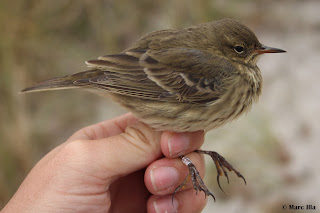
Walk-in-traps are also very useful to catch other 'walking' species, such as Pipits. In fact, by placing them on different places, especially on the beach or the trail in the reedbed, we caught several Tree Pipits (Anthus trivialis), Meadow Pipits (Anthus pratensis), a Red-throated Pipit (Anthus cervinus) and up to 11 Rock Pipits (Anthus petrosus) - only 3 of the latter species had been ringed at the Bird Observatory the last 50 years!!-.
 |
| Tree Pipit (Anthis trivialis), Rock Pipit (Anthus petrosus) and Meadow Pipit (Anthus pratensis) |

 |
| 1st-year (EURING 3) Rock Pipit (Anthus petrosus). Note the moult limit in median coverts, inner GCs and tertials; usually found in the MeC or with 1-2 inner GCs and sometimes possible to detect in the field. |
Most unusual birds this season have been: a Shoveler (Anas clypeata), a breeding female in the area that is only the
second individual ringed of this species in the last 36 years, and first ever
for Flommen, a juvenile European Stonechat (Saxicola
rubicola) – first ever for Flommen - , a juvenile European Cuckoo (Cuculus canorus) – 2nd ever
in the standardised ringing at Flommen -, a first-year female Marsh Harrier (Circus aeruginosus) – 2nd
ever in standardised and for the Bird Observatory -, a first-year female
Blackbird (Turdus merula) – 3rd
ever for the standardised ringing at Flommen -, 30 Penduline Tits (Remiz pendulinus), 23 ringed and 7 recovered from other places, 2 Great Reed Warblers (Acrocephalus arundinaceus), the 57th
ringed at Flommen since 1980 and a recapture from another place in Sweden, 3
Jack Snipes (Lymnocryptes minimus), 3 Spotted Crakes (Porzana porzana) and a Great Cormorant (Phalacrocorax carbo).

But the rarest bird was, without any doubt, the putative Stejneger's Stonechat (Saxicola maurus stejnegeri) (still not confirmed genetically). Don't miss the comparision made by Björn Malmhagen about the Flommen bird and an Stejneger's Stonechat from China; in the same dates the year before and same age/sex combination (first-year female).


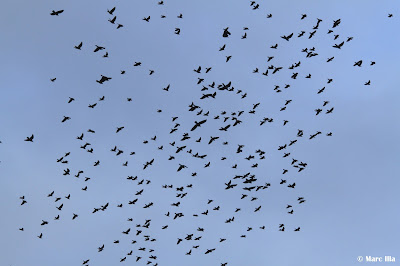
But the amount of migrating birds is what it really makes Falsterbo special. Some days, the sky gets full of migrating birds, usually calling energically (and making a lot ot sound!). You can get huge flocks of many species, with literally thousands of birds flying over!!! This year I stayed longer than other years, until the beggining of October, and those days are especially good to get great numbers of Woodpigeons (Columba palumbus) in migration.

We had also a very special evening with several thousand Cranes (Grus grus) over the peninsula, this picture is taken from the door of the station.

Usually different flocks of different species migrate at the same time, creating a unique scenario!

But you can really see a lot of species migrating in huge numbers. That evening, for example, hundreds of Song Thrushes (Turdus philomelos) and Mistle Thrushes (Turdus viscivorus) were migrating too. And these Redpolls (Carduelis flammea), that somehow look like flying fish!

Such a rather common species across Europe as Sparrowhawks (Accipiter nisus) can be seen in huge amounts at Falsterbo. For instance, 21921 individuals have been counted in migration during 2016's season. Check Falsterbo Bird Observatory's webpage and click on 'Migration counts' to check numbers for other species.

Another great time and experience in such an amazing place. Thanks to everyone one more time: Timmy, Per, Lennart, Karin, Sophie, Caroline, Ingela, Oscar, André, Peder, Björn, Jonas, Johan, Juho, Paul, Kat, PG, Måns, et al.... vi ses sen!!