Tuesday, December 31, 2013

2013 ending tour

Which form could be better to finish a great year such as 2013 than a short trip around Catalunya and Aragó (another Spain region, beside Catalonia)?

We left home on 27th and we went straight to the Ebre Delta. First stop in La Tancada pond, where a Long-tailed Duck (Clangula hyemalis) was supposed to be. In fact, when I was in the Ebre Delta in the beggining of December, this same bird was also supposed to be there, but I wasn't lucky. We found it quite quickly, the bird was an 'advanced' 1w male, with a lot of greyish and whitish feathers, but still with a short tail.

We crossed the Trabucador sandbar looking for seabirds, but the sea was quite rough because of the wind. Nonetheless, the Alfacs Bay was quite calm, and we found again the 'standardised' Red-breasted Merganser (Mergus serrator) group. This time, 22 birds. As in my last visit in these places, there were lots of Calidris, Tringa, Turnstones and Grey Plovers around.

The following stop was in Alfacada observatory, close to Buda Island (in the tip of the Delta). As in my last visit, there was a roosting of Spoonbills (Platalea leucorodia) (this time I just saw 18...), and there were some (21) Common Scoters (Melanitta nigra) close to the beach. Big flocks of ducks were flying and staying in Buda lagoons, and lots of Snipes (Gallinago gallinago) were eating close to the observatory. Among them, I could see a Jack Snipe (Lymnocryptes minimus).

On 28th, we woke up in Flix, some kilometres upstream. We went to Sebes Natural Reserve, a typical place for Bitterns, but we didn't saw any. Actually, nobody has seen one this year there. We left soon to Gallocanta, our next stop, 240 km inland Spain.

About 4:30 in the afternoon we arrived there. Beside Gallocanta village there's a big lake that is a traditional wintering place for Cranes (Grus grus). Thousands of birds overwinter there every year, and we wanted to see this festival. Just 3 seconds after arrive we started to see (and hear..) lots and lots of Cranes around. They were eating on the fields...

We asked for some information in the Information Centre. The nice girl that is there explained us that there were about 50.000 Cranes during these days, and that this is a record number in this time of the year. As is was a bit late, we went as quickly as possible to one of the observatories. When all the Cranes move to sleep inside the lagoon... is magic.


The night started when we were still looking and hearing 50000 Cranes in front of us. In the meanwhile, up to 6 Hen Harriers (Circus cyaneus) appeared above the reedbeds, trying to catch some Corn Buntings (Emberiza calandra) that were sleeping there. Also, the lagoon was full of Shelducks (Tadorna tadorna) (I reckon about 5 or 6 hundred), Northern Pintails (Anas acuta) and some other typical duck's species. Still hearing Cranes, we left the observatory. Minutes after, a nice Barn Owl (Tyto alba) crossed the way, in front of the car, and maybe just 3 minutes later, we flushed out a Short-eared Owl (Asio flammeus). What a nice day!!


29th in the morning, we woke up hearing some Cranes from our room in the Gallocanta's hostel. Then, we went to Ermita del Buen Acuerdo, in front of a chapel in a hill close to the lagoon. The views were fantastic, and there were, again, thousands of Cranes on the water. This time, they were drinking a bit. The girl in the infromation centre told us that, around the midday, is a good moment to see them going to drink. With better light than the evening, we enjoyed the flock a lot. Then, we moved to La Reguera observatory, as the night before, and we continued enjoying this amazing place, with these magnificent birds.


Already in the midday, we left Gallocanta, saying something like 'We will come back quite soon..!'. Next stop was Zaragoza, the main city of Aragó country, because a Long-tailed Duck (Clangula hyemalis) had been found there, in a sort of public park inside the city. As Zaragoza was on the way back home, we went to see that bird. And it was there!!


With the evening coming, we moved to the East. We wanted to sleep in Fraga, in the border between Catalonia and Aragón, but before we wanted to try for Great Bustards (Otis tarda). I just knew a place where it was possible to see one, but we knew that in winter it would be very very difficult because they are not fixed in an specific place or area. I really wanted to see a Great Bustard, but the sun dissapeared on the horizon and the night was coming...
In the last chance, in the last place, we flushed 3 big chickens in front of the car. I just saw a lot of white on the wings, but I quickly knew that they were...! Obviously, 3 Great Bustards flew in front of us and thet stopped in a field quite far. But in a perfect distance to see them with the scope... What a magic moment!


Today in the morning (30th December), we woke up in Fraga. We went to Utxesa ponds, with Bearded Tits (Panurus biarmicus) as the target species. We heard some of them and the saw a couple passing by, not very well but fair enough.

Classic Utxesa's Mute Swans...

Then we visited some other dryland places. We saw big flocks of Calandra Larks (Melanocorypha calandra) and some Southern Grey Shrikes (Lanius meridionalis), but the big surprise was a flock of 94 Pin-tailed Sandgrouses (Pterocles alchata)!


Another great moment was when we found this Eagle Owl (Bubo bubo) hide under a big Rosemary (Rosmarinus officinalis)!

We spend the rest of the afternoon seeing some other typical drylands stuff and checking Skylarks, Meadow Pipits and Linnets flocks, just in case... I guess we will repeat this in incoming winters!!

Thursday, December 26, 2013

Goosander for Christmas!

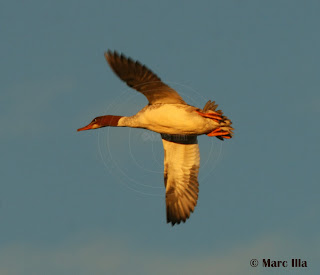
On 17th December a Goosander (Mergus merganser) appeared close to my village, in a lake in the middle of a public park in Manresa. The place is typically good for ducks, grebes and stuff, because it's the biggest lake in the area.


The bird have been seen every day except for two days. Who knows where the bird was... but the thing is that it is there again!
It was really confident, usually swimming with local Mallards (Anas platyrhynchos). As in northern Europe, the birds seemed to be 'at home' being in a public park with lots of people walking around..!


Two years ago (winter 2011 - 2012), we had an influx of mergansers in Spain, with specially some records in Catalonia. I saw my first Goosander then, a bird that had been seen in Manlleu, inland Catalonia and close to my village. In my opinion that bird was a 1w male:

If you look at the flanks (upper photo), you can see a 'yellowish' patch. Those feathers are moulted in the partial postjuvenile moult, and are 'male-type'. Also, the bird had blackish tertials, scapulars and matle feathers (easy to see in the second picture). These traits should be enough to consider the bird as a 1w male.
Then the question is: 'What about the Manresa bird?'


Looking at the bird when is swimming, the well-marked loral stripe is quite obvious. This is always present in juvenile birds, and I think it may be also typical of 1w. Looking at flanks properly, there wasn't any yellowish feather that could indicate male. I found quite hard to see if any flanks or mantle feathers were moulted... but at least there was any feather like the Manlleu bird.

 
  Following what Pyle says, Goosanders do a partial postjuvenile moult and they start to do a complete moult in after the first breeding season (in the second calendar-year). Nonetheless, and I'll copy literally what Pyle says, 'Beware of some HY/SY males do not acquire greenish, blackish, or white feathers until at least Feb-May (and sometimes Sep) and can be difficult to sex by plumage aspect' (HY/SY means 1cy/2cy). So, keeping this in mind, the bird would be called as 'female-type'.

But I'm quite convinced that the Manresa merganser is a 1w female. Apart of the white loral stripe that might be good for 1w, legs are pale-orangish, the bill hook is white (I wonder if this means anything but in some photos I've seen on Internet, these feature is present in birds with a very marked loral stripe), and also the nape feathers are short, but a bit longer than the Manlleu bird. I'm not sure about this thing about these feathers, but I've been looking at some photos and it's length seems to be age and sex related.

Lots of people came to see the bird and I tried to find some photos of the wing. We finally got some photos of the wing. Again, following Pyle, the secondaries and GCs pattern fix with a 1w, with a difuse blackish tip in GCs and absent is SS. In some photos (like the one below), primaries seems to be a bit pale. Maybe another good trait for 1w?
Photo by Bernat Ferrer.
Last Saturday, José Portillo, that is doing the Big Year in Spain (and who has seen 413 birds this year!!!!), came to see the 414. A crazy number that is the result of lots of trips to every corner in Spain. And he has seen already 415 species today... Some other friends came to see the Goosander and we ate something while we were looking at 'her'.


Have good Christmas days!!!

Monday, December 23, 2013

Winter holidays

My winter holidays had already started! Last days I've been ringing and birding aroud my hometown.
My feeling is that, this year, there are less Fringillidae species than other winters. Actually, I've counted about 600 Chaffinches (Fringilla coelebs) less than 2012, but the numbers are on the average for a normal winter. As you can see, last winter was specially a good year, with also lots of Bramblings (Fringilla montifringilla) everywhere (this year I've just seen one).
Comparisation between winter counts doing my SOCC
 (the Catalan census part of the Pan-European Common Bird Monitoring Scheme).
'Primavera' means 'Spring' and 'Hivern' means 'Winter'.
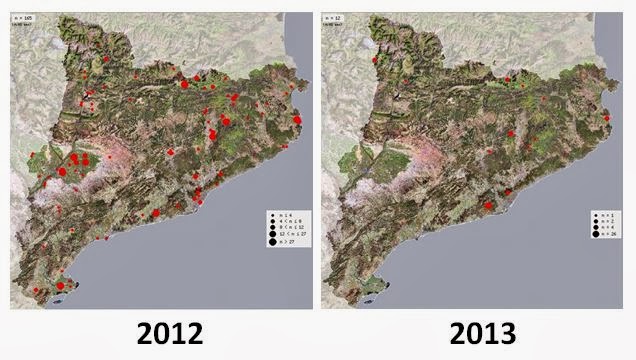
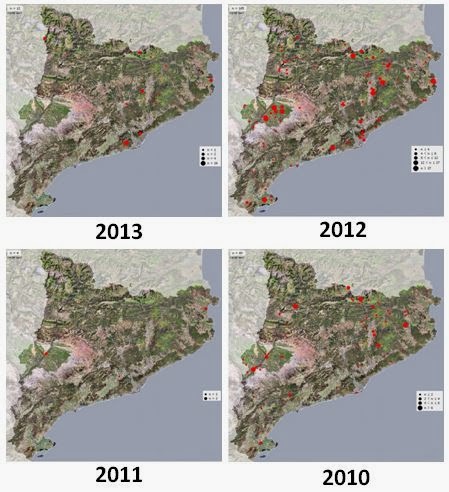
Looking for Brambling's sightings in ornitho.cat, I've generated these maps: (click to enlarge)
The sightings are extracted from the period 1st October - 25th December in every year. I've also added 2011 and 2010 in the next analysis:
2011 was bad for Bramblings, 2012 a reaaly good year,
and 2013, as 2010, is like a 'normal' season for these species.
All information comes from www.ornitho.cat database.
Also, as Marcel Gil pointed out, in Falsterbo they had record numbers of ringing and migrating Siskins (Carduelis spinus), but in Catalonia we have just seen a few. Millions of them might be on the way, somewhere in central Europe!, but they hadn't reached Catalonia yet.

On the other hand, at least in my area, there are obviously more Chiffchaffs than other years. In my usual ringing places, I've already trapped more collybitas than the last year during the whole winter!

Last year I also started to ring in some roostings. My main targets were (and still are) Reed Buntings (Emberiza schoeniclus) and Yellowhammers (Emberiza citrinella). I've found a new place for schoeniclus and I've ringed about 40 these days. And I retrapped one with an Spanish ring! (ICONA ring; I still don't have any information about when and where was ringed).


Yellowhammers are sleeping in the same roosting as every year, a small reedbed in the middle of a big dry lands area. They prefer a corner without water on the floor and with some bushes around.

I've also trapped some typical winter visitorsin these reedbeds:
Adult Cetti's Warbler (Cettia cetti) male, wing length = 66 (!)
This bird was ringed 16th October 2011 as 1st year, with
wing length = 62 !
1st-year male Sardinian Warbler (Sylvia melanocephala),
easy to age even in the field.
1st-year Stonechat (Saxicola rubicola)
1st-year Dunnock (Prunella modularis)
There was a flock about 40 Meadow Pipits (Anthus pratensis) close to the reeds and I tried to play some calls close to a bush surrounded by nets. I finally trapped 3!, all of them 1st winters.


The biggest surprise came on 17th December, when while I was moving from a schoeniclus roosting to the yellowhammer's place, I received a call from Sergi Fernández. He said that was just found a Mergus in a big lake in a public park in Manresa. I went straight to that place and I could see it just after arrive: a Goosander (Mergus merganser)!, that is a rarity in Spain.

Wednesday, December 18, 2013

Winning streak

More than one month ago, I started a great winning streak. Last week's Tuesday, after the really nice birding weekend in the Ebre Delta, I decided to go to Aiguamolls de l'Empordà, in the northeast corner of Catalonia, because I had one day without university classes.

While I was in the Ebre Delta I received some 'bird alerts' about a Bean Goose (Anser fabalis) that had been found there. Also, a Goosander (Mergus merganser) and a Red-throated Diver (Gavia stellata) had been seen during the weekend, so I though it was a good place to go.

The Cortalet pond was full of ducks and geese, as it should be. I was surprised about the number of Wigeons (Anas penelope). I saw 86 birds, that is not a bad number. Most of geese were sleeping, but I started to look carefully each one. In the meanwhile, some Shovelers (Anas clyepata) were really close to the hide.

Some geese started to get closer...

Cortalet's vista from the first hide.
The first not-Greylag Goose that I found was the putative hybrid between Barnacle and Canada Goose (Branta leucopsis x canadensis). This bird was found for first time in 11th October, and it will be there until the end of the winter. It's interesting to see how the 'shape' of these hybrids remind features of hutchinsii.


I counted 260 Greylag Geese (Anser anser), and one of them was a bit weird. I was almost sure it was the Bean Goose, but the bird was 'sleeping' inside the lagoon, so I couldn't see the head neither the legs. I waited during some minuetes, and I was getting more and more sure that it was undoubtedly the Bean Goose. Actually, I had never seen one before (I tried it on Fasterbo but I left before they arrived), so I think that if I had some doubts, it was because I had never seen one. It's quite noticiable the flank colouration, with a more broad and well-defined white stripe, the darker centres of mantle feathers and the broad white marks intertials edges (as you might be suspecting, the bird was an adult). Also, primaries are a bit longer than Greylags, and when you see the bird resting, you can see that they're equal or longer than the tail feathers.


Finally, the Bean Goose raised the head and I could enjoy it. I think it was really nice to find it when it was sleeping, I think it was the best way to learn about this 'new' species for me. Minutes after, the 2 first-winters Greater White-fronted Geese (Anser albifrons) that appeared on 31st October. This species has became regular in this area, with some birds overwintering during last years...

When the Bean Goose showed me their head, I was invaded by an strange feeling. The orange are on the bill was restricted near the tip, like a rossicus, but we know that some fabalis can have this bill designs as well. This Siberian ssp. had never been seen in Catalonia, so this would be the first... I managed to check the bill shape but I had an impression that I was to longer for rossicus. Actually, the bird had a short and string neck, but I though it was normal...
Now it seems that this bird is an actual rossicus. I reccomend to read Marcel's post (he went there three days after me). When I went back home I remembered the same BF post that Marcel is talking about. Who knows from where this bird is coming...

We moved to another hide, looking still the Cortalet lagoon. There was a flock of 15 Flamingos (Phoenicopterus roseus), and also 5 Northern Pintails (Anas acuta).

  If in the other observtory I was distracted with Shovelers, then my pastime where Great Cormorants (Phalacrocorax carbo). If they show me their moult limits in this way... it's impossible to not take a look!

 We left Cortalet and we followed the way to the beach. We stopped to see some Fallow Deers (Dama dama) that were resting in a meadow. We saw 35 of them, mainly females and young deers but also two nice males.

Matà meadows were almost empty of waders, but plenty of Reed Buntings (Emberiza schoeniclus). I think we saw about 80 birds between the spider webs!


Besides the Reed Bunting flock, we saw just
1 Marsh Harrier and this Cattle Egret...
Asa every winter, we did a quick visit to the Common Teals (Anas crecca) in the Bruel hide. Some of them usually rest just in front of the observatory, and it's always nice to take a couple of pictures...


We reached the beach in the midday. The sea was really calm, almost flat, so perfect for Divers and stuff. Firstly, I saw a couple of Velvet Scoters (Melanitta fusca) that had been observed for some days there, and just after I found the RT Diver (Gavia stellata) that was found the last weekend. With the town of Roses in the background, I found 3 Black-throated Divers (Gavia arctica), that are always common in this Bay. Going back to the stellata, doing a quick check to the closest part of the sea, 2 RT Divers appeared, really really close! I got very excited then, but even more when I found again the same individual that I had seen before, and even more when a 4th bird appeared. Then, I saw another further Diver that at couldn't ID at first sight. It got closer, just behind the stellatas, and it was... a Great Northern Diver (Gavia immer)!
Two Stellatas...out of 4!

Wednesday, December 11, 2013

Keep the tradition

It's the third year in a row that, with some friends, I'm going to Ebre Delta in December. After the great success last year, I was extra motivated to find a ot of nice birds and to have a great time.
Sadly, the usual crew was affected by university stuff, and Josep, Joan and Ferran couldn't come. So, this year, we have gone just Bernat and me.


We arrived on Friday morning and we went straight on Sant Antoni saltpants, a typical place for waders and where a Long-tailed Duck had been observed some days ago. We weren't lucky with the Long-tailed, but we enjoyed a big flock of Dunlins (Calidris alpina) (526 birds), with some Sanderlings (Calidris alba) (126) and Little Stints (Calidris minuta) (69) mixed in. As the first surprise, a Red Knot (Calidris canutus) was also there. Knots are scarce during the winter, but there're always some in the Ebre Delta every year. As always, we saw a lot of Redshanks (Tringa totanus) (122 to be concise), Greenshanks (Tringa nebularia) (22), Grey Plovers (Pluvialis squatarola) (44), Kentish Plovers (Charadrius alexandrinus) (39), Turnstones (Arenaria interpres) (10)...


Then, we drove along the Trabucador beach. There was no wind, and the sea was really calm, perfect for seawatching. We started seeing 2 Bonxies (Stercorarius skua), and soon we find a Razorbill (Alca torda). In the usual place, inside the Alfacs Bay, we saw a flock of 18 Red-breasted Mergansers (Mergus serrator) eating, and as always, it was full of Crested Grebes (Podiceps cristatus) and some Black-necked Grebes (Podiceps nigricollis).
Trabucador beach
We were stopping in random places in the middle of the beach, just because of 'birding feelings'. We had got success in every stop when we decide to do it again. For first time, there was nothing on the sea... but suddenly, a Red-throated Diver (Gavia stellata) appeared, flying, just in front of us. I saw it pretty well with my scope when it decided to dissapear in the sea. This was probably the best moment of the weekend!

In the afternoon, we went to Alfacada, another typical but fantastic place. Looking at the sea, 11 Common Scoters (Melanitta nigra), another Bonxie (S.skua) and 1 Black-throated Diver (Gavia arctica).

  The lagoon was, as always, full of ducks. Hundreds, maybe thousands of Shovelers (Anas clypeata) and Common Teals (Anas crecca), about 250 Northern Pintails (Anas acuta), above 200 Shelducks (Tadorna tadorna)... We saw also a flock of 41 Eurasian Spoonbills (Platalea leucorodia) and 1 Moustached Warber (Acrocephalus melanopogon) as the best sightings.


The day after, on Saturday, we started early in the morning walking around some beaches. We saw lots of Reed Buntings (Emberiza schoeniclus), and sadly nothing special was mixed in. Nonetheless, we saw about 40 Lesser Short-toed Larks (Alaudala rufescens) displaying. During all morning we heard shots because it was a 'hunting day'. All the lagoons were almost empty, so we decided to check the see again.

We found the firsts Melanittas soon, 3 nigra swimming close to the beach we checked. We went again to the Trabucador beach, and we found one Red-breasted Merganser more (so 19). We walked to Punta de la Banya, where all ducks go when there're hunters around. All birds were too far, but at least we saw 39 Audouin's Gulls (Larus audouinii), a regular wintering species in the Ebre Delta and the southern coast but always in small numbers. We decided to spend the afternoon looking for the Pacific Golden Plover that has been in the Delta since last August. It would had been nice to see it again, already in winter plumage, I just saw it when I was ringing in the Delta on September. Durint the last quick look at the sea, we found a really nice Velvet Scoter (Melanitta fusca), relatively close to the coast.
  
Common Scoters (Melanitta nigra)
We didn't find any Pacific Golden Plover during the afternoon, but the views of the sunset in the ricefields, with lots of Calidris (basically Dunlins) flying, calling and running around were so nice.


Sunday was the last day, so we decided to start as early as possible to avoid hunters at least for some hours (yeah, two hunting days in a row...). We started at Alfacada observatory, with big flocks of ducks in the lagoon. There was just 1 Common Scoter in the sea, and we saw also 1 Bonxie. I checked carefully the flock of 188 Greylag Geese (Anser anser) that was resting on the beach, but anyone of them looked weird. The most unexpected bird was a Black-winged Stilt (Himantopus himantopus), really scarce in winter in Catalonia but with a few birds wintering every year in the Delta.


When first hunters arrived, we decided to go again to do some seawatching. We found again the Velvet Scoter in the same place, as well the 3 Common Scoters we had seen the day before. Then, we find a new group of 9 M.nigra. We did a quick visit to Riet Vell, where we saw some nice Bluethroats (Luscinia svecica), and also to Encanyissada ponds.


Already in the midday, we went to the northern part, Fangar Bay, to look for some waders. We found quickly a big flock of some species: Dunlins, Sanderlings, Redshanks, Grey Plovers... and between them, 6 Red Knots!
Red Knot (Calidris canutus)
Bar-tailed Godwit (Limosa lapponica)
We go back to the Velvet Scoter's place, and it was still there. This time, followed by 9 Common Scoters more, an unexpected Parasitic Skua (Stercorarius parasiticus) (also scarce but regular in winter) and 1 Black-throated Diver (Gavia arctica). As we had seen so many birds in the sea, we went to another beach. There, we found 9 Common Scooters more (I don't think the same flock was following me...). The sun was disappearing when we went to La Tancada laggon, where lots of Flamingos (Phoenicopterus roseus) roosts, to do the 'stardardised count'. We finally managed to do it: 4183 birds.


Already in the dark, we drove back home. We had a really nice birding weekend, and we also found lots of friends that did everything greater. As I said last year, 'Let's see if we can do thi every December!'